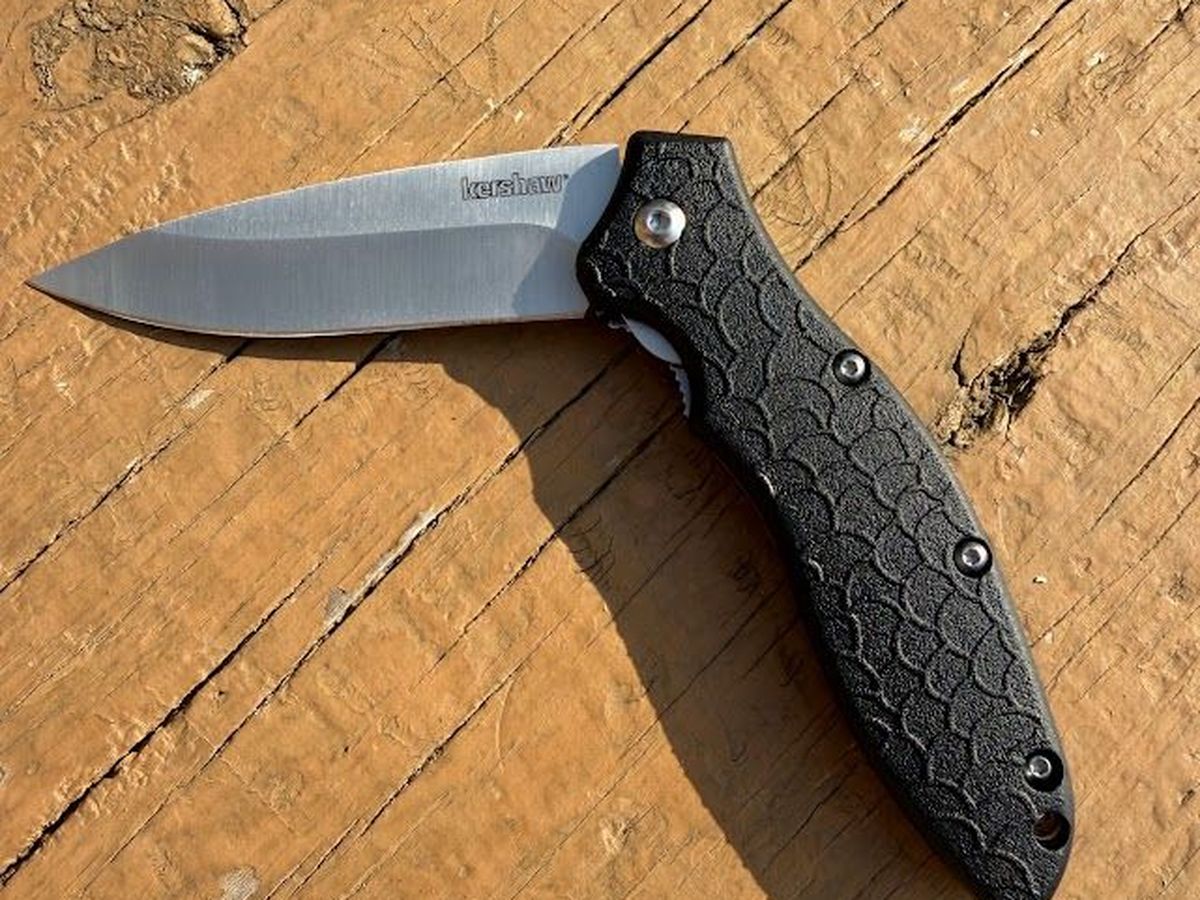
This knife lives in the center console of my Tacoma. That sentence is most of the review, but it's worth unpacking, because “the knife I keep in the truck” is a real category and almost nobody reviews for it.
The Oso Sweet is a Ken Onion design that Kershaw sells for around thirty dollars. At that price you expect compromises, and there are some. What surprised me is where they aren't: the ergonomics are genuinely good, it weighs 2.8 oz, and after a year of being thrown in a console and forgotten about, it still opens and locks the way it did new.
It has bailed me out more than once four-wheeling on the beach — most memorably cutting cordage to tie gear down when the wind came up hard. That's the job. It doesn't need to be a nice knife. It needs to be there, and to work when it is.
What works, what doesn't
Holds up
- Ergonomics well above the price — the handle fills the hand properly
- 2.8 oz, so it disappears in a pocket or a console
- Value is close to absurd at street price
- Hollow grind on thin stock makes it a genuinely good slicer
- Liner lock is unremarkable in the best way — it just works
Falls short
- The assisted-opening spring is the part I'd expect to fail first, long term
- 8Cr13MoV is a concern on paper — though not one that has shown up in practice
- Glass-filled nylon handle feels like what it costs
Specifications
- Blade length
- 3.1″ / 7.9 cm
- Blade steel
- 8Cr13MoV stainless
- Blade stock
- 0.108″ / 2.75 mm
- Grind
- Hollow, satin finish
- Blade shape
- Drop point
- Weight
- 2.8 oz / 80 g
- Closed length
- 4.1″ / 10.5 cm
- Overall length
- 7.1″ / 18 cm
- Lock
- Steel locking liner
- Opening
- SpeedSafe assisted — flipper and thumb studs
- Handle
- Glass-filled nylon, scale texture
- Clip
- Reversible tip-up / tip-down
- Designer
- Ken Onion
- Origin
- Made in China
- Price
- ~$30 street · $54.99 MSRP
Score breakdown
Five categories, each scored out of 10. The profile reads left to right like a trail elevation chart — peaks are where this knife earns its price, and the drop at the end is the one thing I’d watch.
The blade, technically
Most reviews at this price stop at “sharp enough.” The Oso Sweet is more interesting than that, because the geometry is doing more work here than the steel is.
The steel: 8Cr13MoV
8Cr13MoV is a Chinese stainless roughly comparable to Japanese AUS-8. It runs about 0.8% carbon and 13–14.5% chromium, with small additions of molybdenum and vanadium. That chromium content is what makes it genuinely stainless rather than merely stain-resistant — relevant for a knife that lives in a vehicle through humid Virginia summers and gets used near salt water.
Kershaw doesn't publish a single hardness figure and retailer listings disagree with each other, but 8Cr13MoV is typically run somewhere around 58 HRC. That's the deliberate part: the carbide structure is fine and the hardness is moderate, so the steel takes a keen edge quickly on almost any stone and gives that edge up sooner under abrasive load. It is a trade, and it is the right trade for a knife you will actually sharpen rather than baby.
On paper this is the weak point. In practice, for me, it has not been one. A year of cordage, packaging, and general truck-knife duty has not produced a moment where I wished for better steel. Rope is not what dulls a blade fast — cardboard, dirty surfaces, and cutting into grit are, and that is not the work this knife does for me.
The grind: hollow, on thin stock
This is where the cutting performance actually comes from. The blade is 0.108″ — 2.75 mm — which is thin for a 3″ folder, and it is hollow ground, meaning the bevel is concave rather than flat. A hollow grind removes material from behind the edge, so there is less cross-section to push through whatever you are cutting. The result is a knife that slices well above what the steel alone would suggest.
The trade-off is lateral strength. Less steel behind the edge means less support, so a hollow grind on thin stock is more prone to rolling or chipping if you twist it, pry with it, or drive it into something hard. That is a geometry limit rather than a steel limit, and no amount of premium steel would change it. Treat it as a slicer and it performs. Treat it as a pry bar and the edge will tell you.
The profile: drop point
A drop point brings the spine down in a gentle convex curve to meet the edge, which puts the tip closer to the centreline of the blade than a clip point does. Two practical consequences: the tip has more material behind it and is meaningfully harder to snap, and you get a continuous belly for slicing rather than a straight edge ending in a sudden point.
That tip strength is why I am comfortable with this as a knife I do not think about. Fine-tipped folders are better at delicate work and they break when someone uses them as a screwdriver at the wrong moment — which is exactly the moment a truck knife gets used.
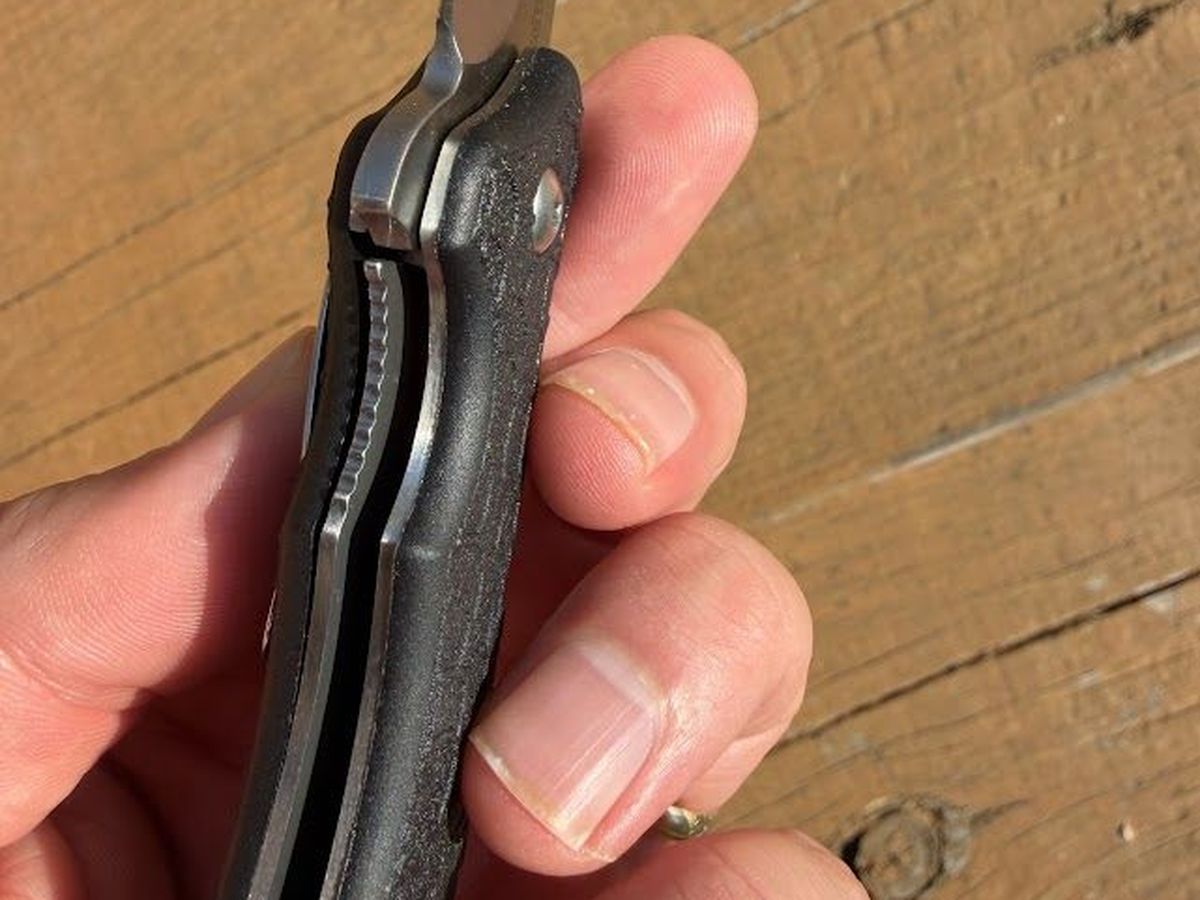
Satin finish
The machine satin finish is cosmetic rather than protective. It is a directional polish, not a coating, so corrosion resistance comes entirely from the chromium in the steel. After a year of humid storage and beach trips there has been no rust, which is the answer that matters more than the specification.
Field performance
The specific test this knife keeps passing is being forgotten about. It sits in the console between the seats through a Virginia summer, and whatever the inside of a parked truck reaches in August, and it comes out working. The detent is still crisp. The blade is still centred. The lock engages where it always did.
The clearest moment was on the beach, four-wheeling, when the wind came up hard and gear needed tying down properly right then. Cutting cordage to length is exactly the geometry this blade is built for — thin stock, hollow grind, continuous belly — and it went through it without drama. I had not thought about that knife in weeks. That is the entire value proposition.
Ergonomics
The handle is better than a thirty-dollar knife has any business being. The scale texture on the glass-filled nylon gives real grip without the sandpaper feel that shreds a pocket, and the finger choil and slight palm swell mean it locates in the hand the same way every time. At 2.8 oz there is no weight to fight.
The lock
The steel locking liner is fine. Not remarkable, not concerning — it engages consistently, it holds, and it releases without a fight. For the cutting this knife does, that is all a lock needs to be, and I would rather have a good ordinary liner lock than a fancy mechanism at this price.
What I would watch long term
The SpeedSafe torsion bar is the part I would expect to give up first. It is a spring under repeated load, and springs are a wear item in a way that a blade and a liner are not. Mine shows no sign of weakening yet. But if this knife eventually stops being useful, I think that is how it happens — not the steel dulling and not the lock failing.
Comparing options?
All 20 pocket knives ranked side by side — steel, lock type, weight, and value in one table.